
Vintage watches under €1,500: Omega, Longines, Universal Genève
By Charlemagne Bijouterie HorlogèreUpdated on 9 min read
The best pleasure-to-price ratio in vintage watchmaking
One budget changes everything in Swiss vintage, and it is not €1,000. Under €1,000 you will find handsome pieces, but the choice narrows quickly as soon as you want a healthy case, an original dial and an in-house calibre. At €1,500 the market opens right up: automatic Omegas from the 1960s, Constellation chronometers, Universal Genève, gold-plated Longines, and a whole tier of less publicised Swiss makers doing the same job for a third of the price of a Rolex.
This guide is based on what actually comes through the workshop in Herstal. No forum theory: precise references, identified calibres, and the market values recorded in 2026 on the Belgian and European market.
Omega: the serious entry point, between €600 and €1,500
Omega remains the most rational brand at this budget. The brand produced watches in huge numbers through the 1960-70 period, and the documentation is excellent: every reference and every calibre can be traced.
The calibres to know
Three families cover most of what you will meet under €1,500.
The calibres 550 to 565 are Omega's classic automatics, produced from 1958 to 1970. The 552 (no date), the 562 and the 565 (date) are robust, easy to regulate, and spare parts still circulate. A 565 in good condition holds +/- 10 seconds a day without difficulty.
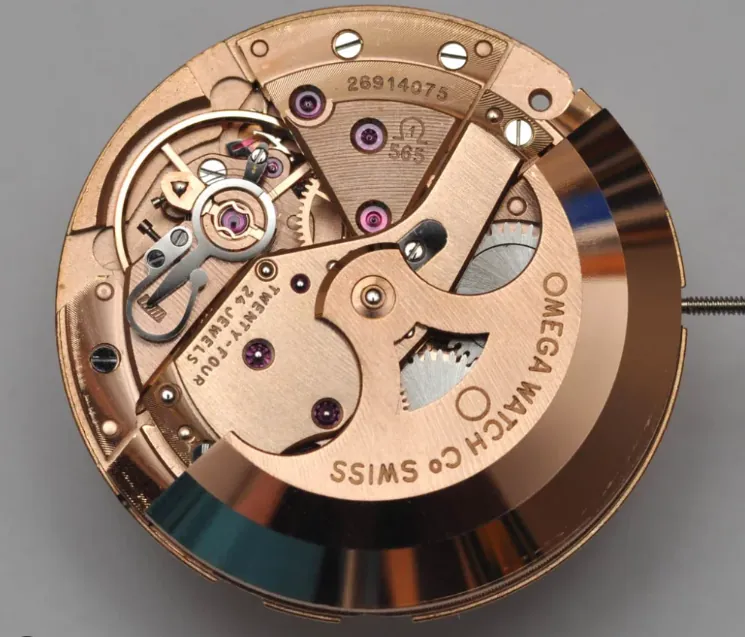
The Omega calibre 565, a 24-jewel automatic with date, one of the most reliable movements of the 1958-1970 period.
The calibres 1010 to 1022 took over in the early 1970s. They beat at 19,800 beats per hour, gain in precision, and power the Seamasters of the period. They are often the best value on the market today: less fetishised than the 5xx, technically more modern.
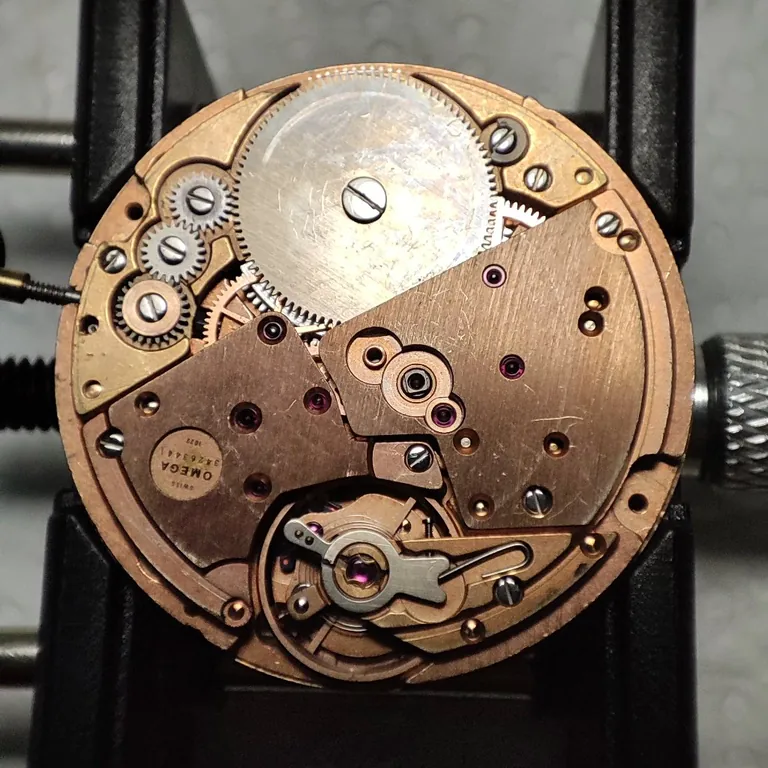
The calibre 1022, successor to the 5xx: 19,800 beats per hour and a rate that stays stable over time.
The calibre 564, and its chronometer version 751 with quick-set date, power the Constellation. This is the top of Omega's series production: adjusted in five positions, with an observatory certificate at the time.
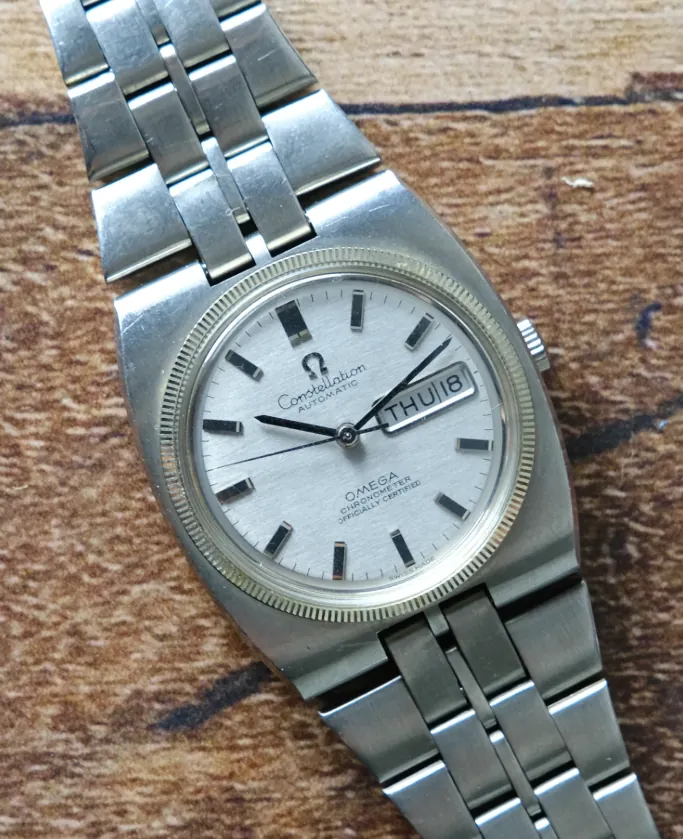
Constellation 168.045, calibre 751 chronometer with quick-set day and date.
What you actually find
In the shop, the range reads like this. Around €600, an Omega Dynamic 165.039 with calibre 552, its ellipsoidal case designed by Raymond Thévenaz, one of the most recognisable shapes of the seventies. Around €800, a Seamaster DeVille 14775 with calibre 610 or an Automatic Day/Date 166.0209 with calibre 1022. Around €900 to €1,000, a Seamaster Cosmic 166.026 with calibre 565 or a DeVille 162.0060 with calibre 1012.
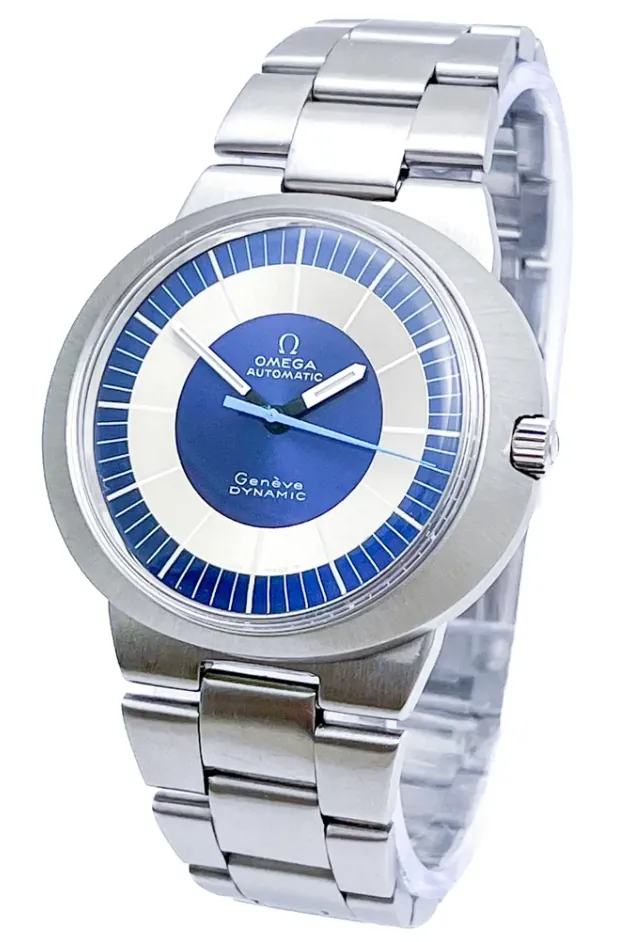
Omega Dynamic 165.039, calibre 552: ellipsoidal case and blue sector dial, around €600.
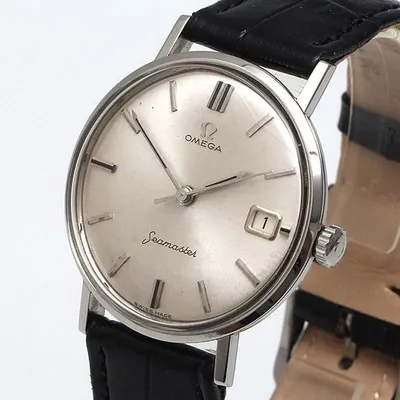
Seamaster DeVille 14775: the classic 34 mm line, silvered dial and date window, around €800.
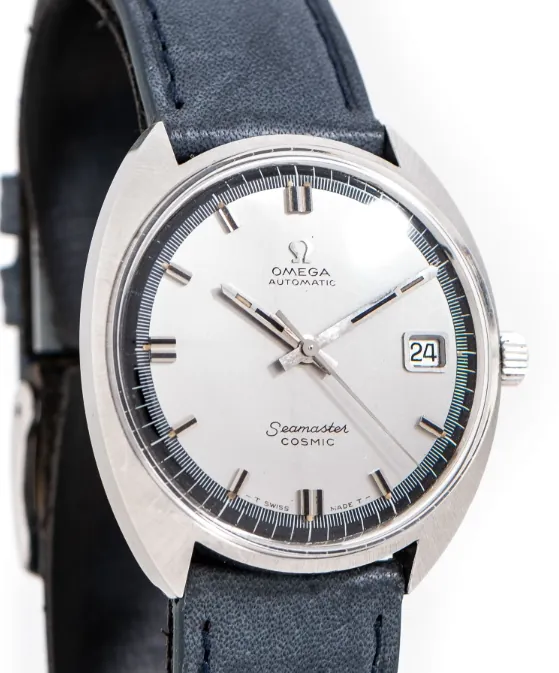
Seamaster Cosmic 166.026, calibre 565: two-tone dial and case with drooping lugs, €900 to €1,000.
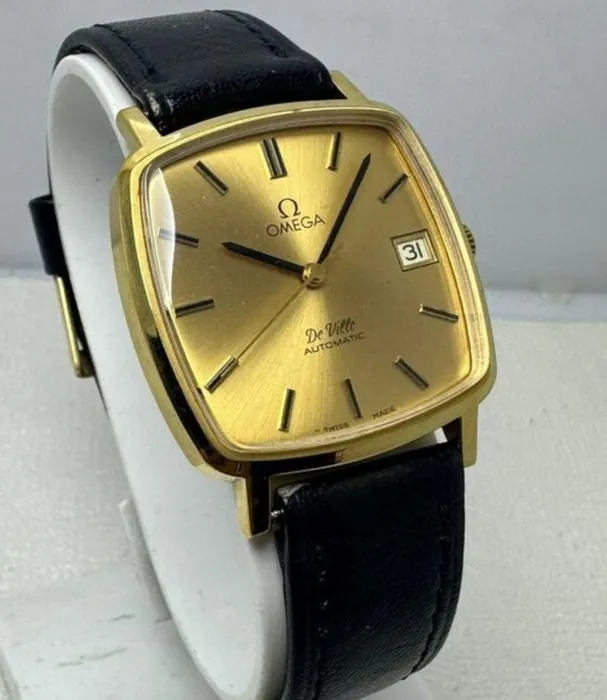
Omega DeVille 162.0060, gold-plated cushion case, the most affordable dress watch in the range.
Above €1,000 you enter the territory of watches you keep: Constellation 168.045 with calibre 751, Seamaster TV 166.020 with calibre 1020 and its much sought-after television case, Seamaster Day/Date 166.0216, and up to the Constellation 168.017 with calibre 564, which tops out around €1,550.
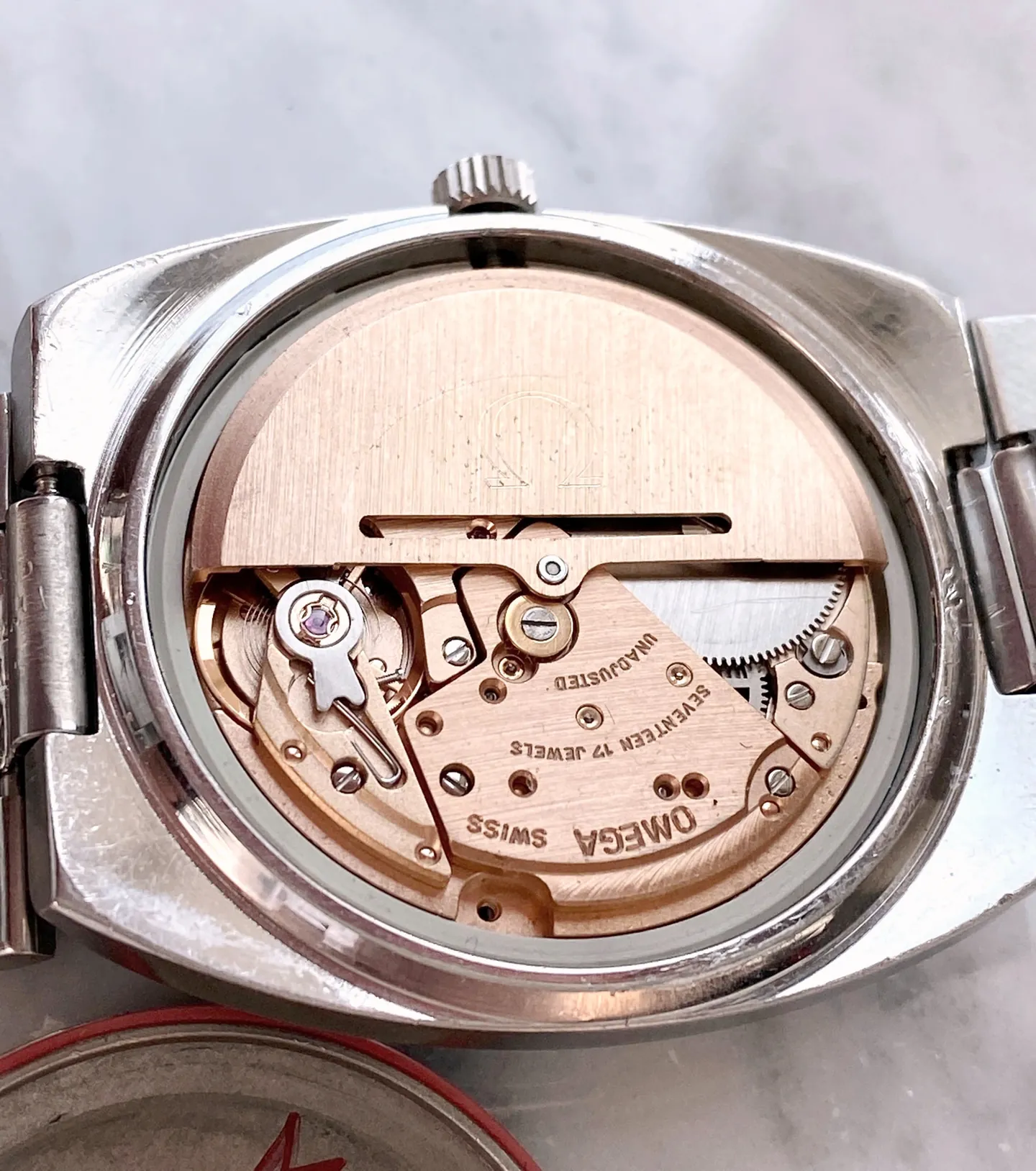
The calibre 1020 in its case: rotor signed Omega and the engraving "seventeen 17 jewels".
The point to watch
With Omega, the question is never the movement. It is the dial. A redial costs 40 to 50% of the value. The signs of an original dial: crisp printing of the logo under a loupe, perfect alignment of the applied indices, patina that is uneven rather than uniform like paint. A dial that looks too perfect on a watch from 1965 should raise suspicion.
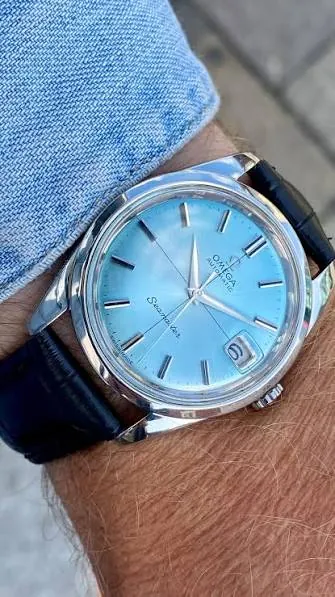
An example of a redial: colour too uniform, logo printing clogged, no patina at all. The value drops by 40 to 50%.
Universal Genève: the connoisseurs' brand
Universal Genève is the name collectors say under their breath. The house produced the Polerouter, designed in 1954 by Gérald Genta, the future author of the Royal Oak and the Nautilus. It is literally an affordable Genta.
The Polerouter uses the micro-rotor calibre 215, then the 218, a feat of miniaturisation that allowed a slim case despite automatic winding. It was created for SAS pilots flying over the North Pole, hence the name.
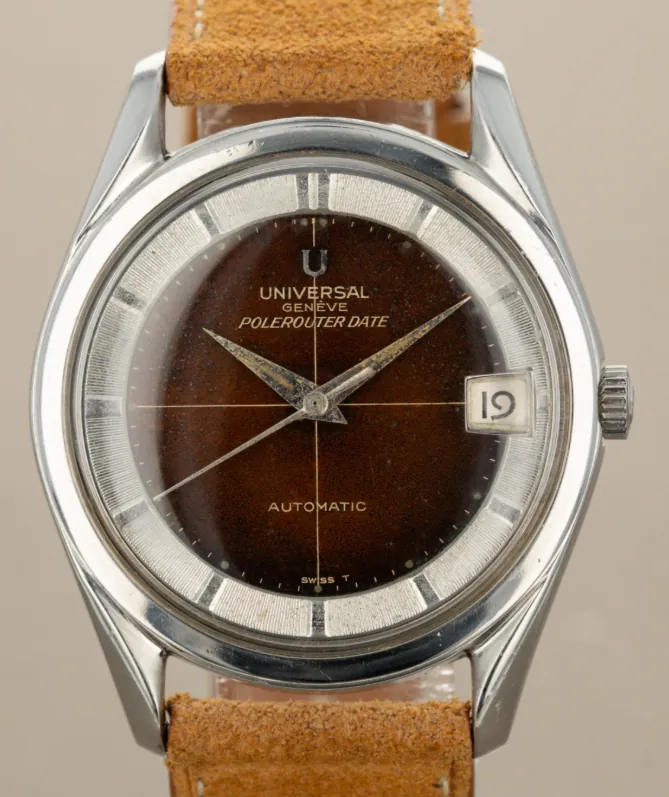
Polerouter Date: brown tropical dial, twisted lugs and applied indices, the Genta signature of 1954.
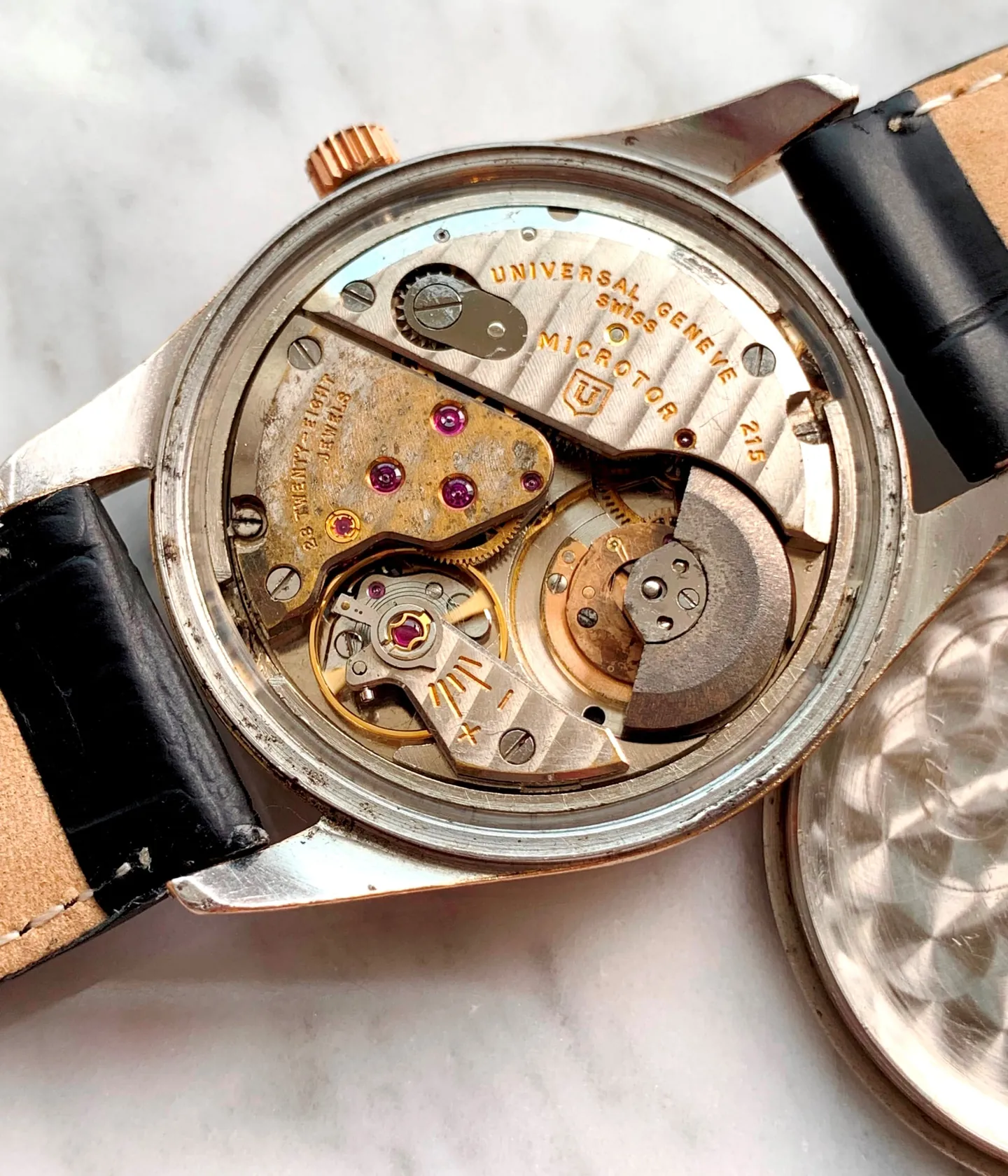
The micro-rotor calibre 215, 28 jewels: automatic winding without any surplus thickness.
The market caught on five years ago. A Polerouter in a steel case now trades between €1,200 and €2,500 depending on the state of the dial. The gold-plated versions, such as reference 677-085, remain more affordable at around €400 to €600, and are the best way into the brand. At that price, it is a Genta design on the wrist.
Longines: the manufacture the market forgot
Longines won more observatory prizes than any other Swiss house. It equipped Lindbergh, Amelia Earhart and the polar expeditions. Its in-house calibres of the 1950s are technically the equal of what Omega was doing at the same time. When Swatch took over and repositioned the brand as mid-range, it damaged the brand's image, not the quality of the older watches.
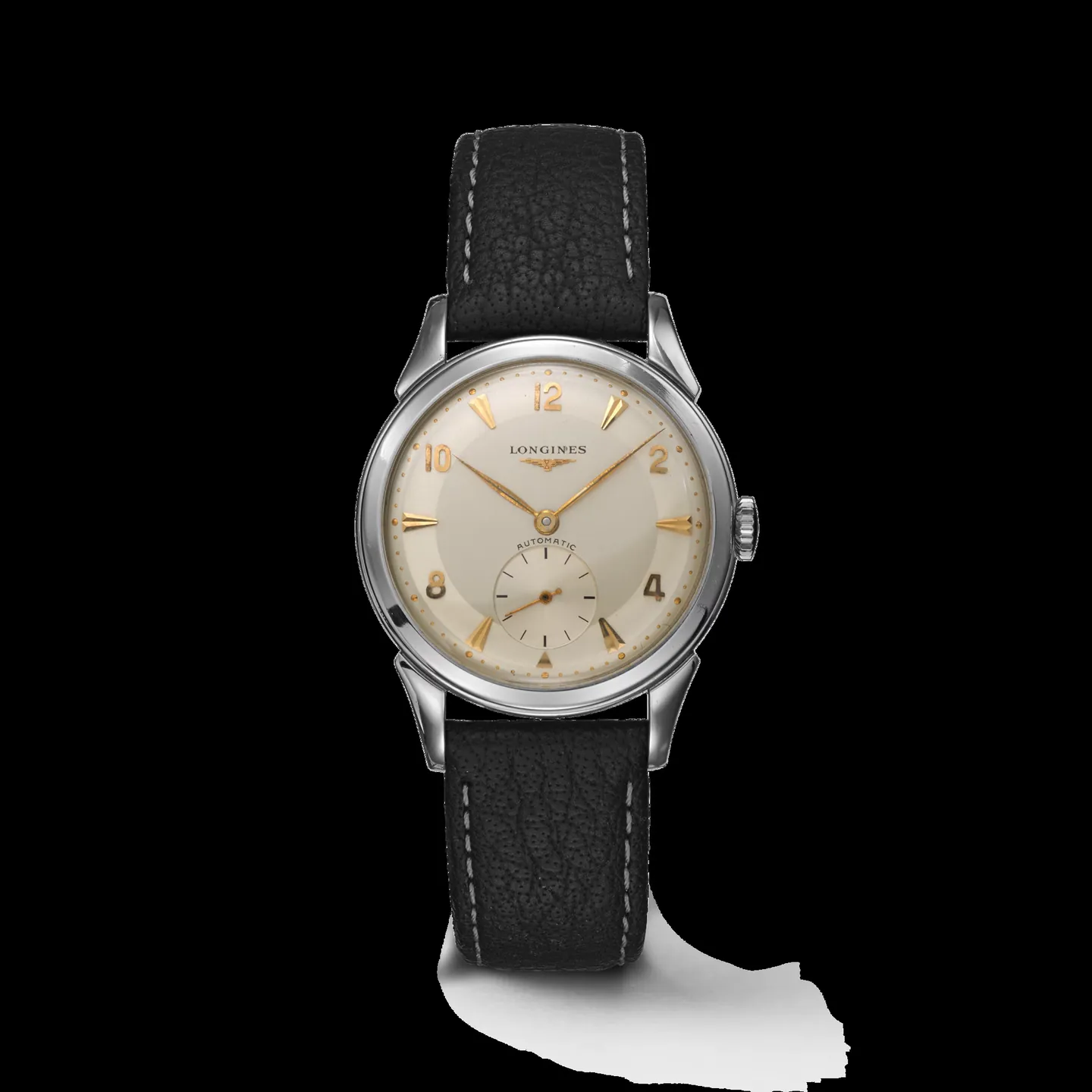
Longines went along on the polar expeditions: a reputation for precision built in the field, not in a display case.
The calibres to remember are the 30L, a 17-jewel hand-wound movement of surprising regularity, and the 12.68Z of the 1940-50 period, older but superbly finished.
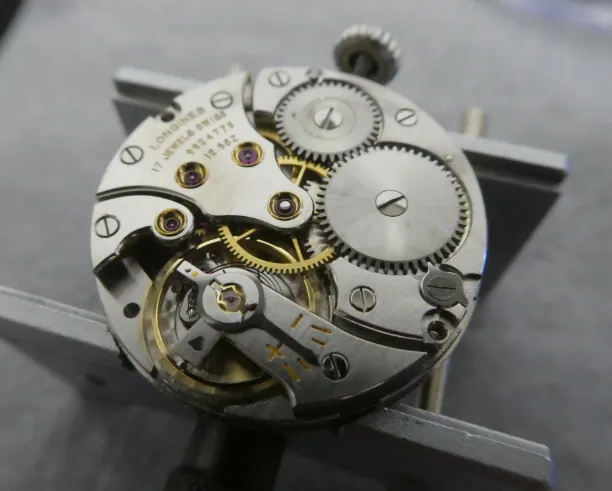
The Longines calibre 12.68Z: finishing, anglage and regularity from a genuine manufacture of the 1940-50 period. The Conquest, Flagship and Admiral models cover the automatic production of the 1950-60 period.
Beware of one detail that catches many buyers out: the Longines-Wittnauer watches sold on the North American market. Wittnauer was Longines' American distributor, and some pieces carrying both names have Longines movements inside, others do not. A Longines 23Z Wittnauer in 10-carat gold plate sits around €900, which remains an excellent way into a signed in-house calibre.
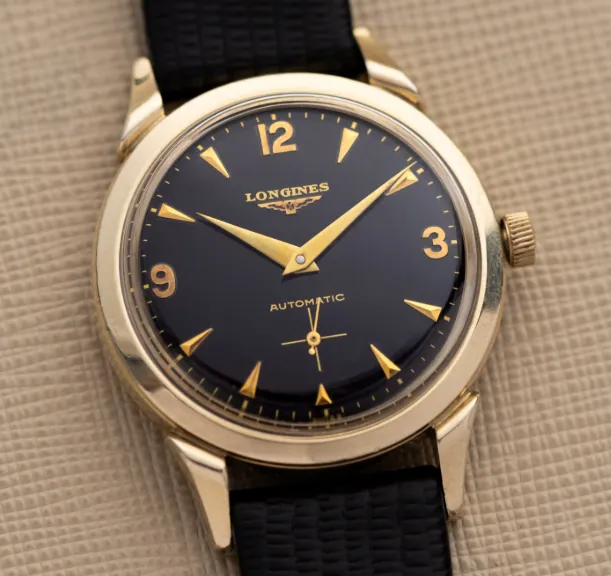
Longines 23Z distributed by Wittnauer: black dial, applied gold indices, automatic in-house calibre.
Tissot and Zenith: two leads worth watching
Tissot is the most undervalued brand of the lot. The automatic Visodate of the 1950-60 period, with its calibre 784 and its date window, can still be found between €300 and €600. The PR 516, with its pierced holes inspired by racing steering wheels, runs from around €400 to €800 depending on whether it is the chronograph or the three-hand version. The calibre 781/784 is solid, and Tissot belonged to the same group as Omega, which is why the construction feels so similar.
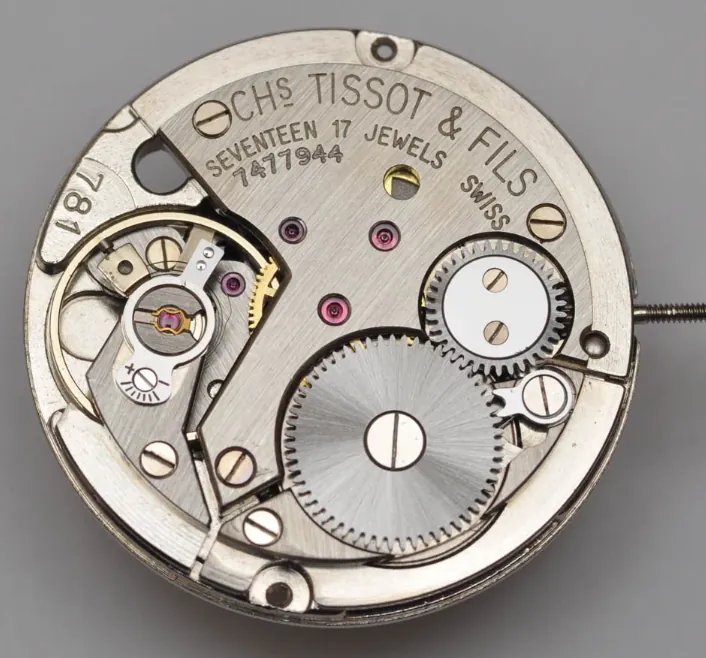
The Tissot calibre 781, 17 jewels: construction close to the Omegas of the same period, for a third of the price.
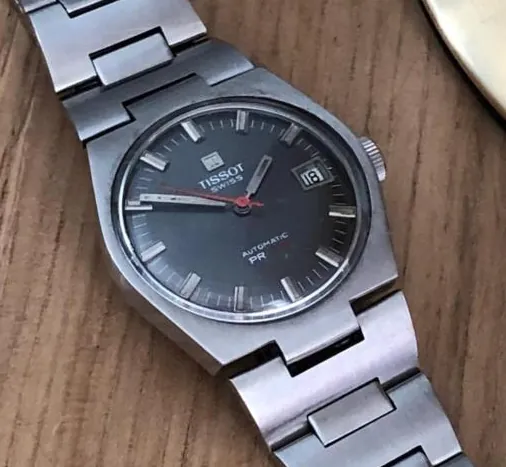
Tissot PR 516 automatic: black dial, bracelet with pierced links inspired by racing steering wheels.
Zenith is the opposite case: the brand is known for the El Primero, but everything that is not an El Primero stays in the shade. A Zenith Sporto or an automatic Surf from the 1960s, with calibre 2532 or 2542, trades between €500 and €1,000. This is a fully integrated manufacture, making its own movements since 1865, at high-street brand prices.
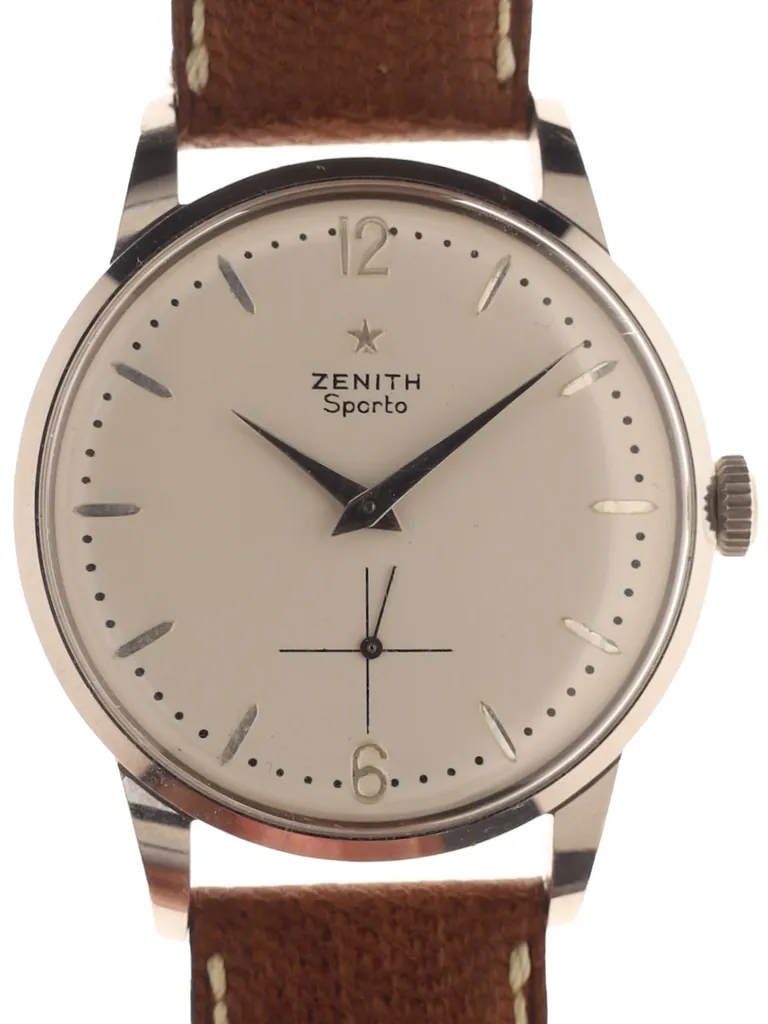
Zenith Sporto: cream dial, small seconds at 6 o'clock and applied indices, an accessible manufacture at around €500 to €800.
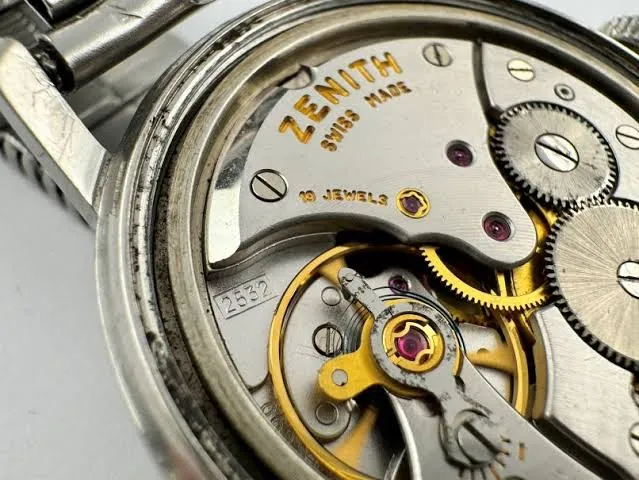
The Zenith calibre 2532, 19 jewels: manufacture finishing and spare parts still available.
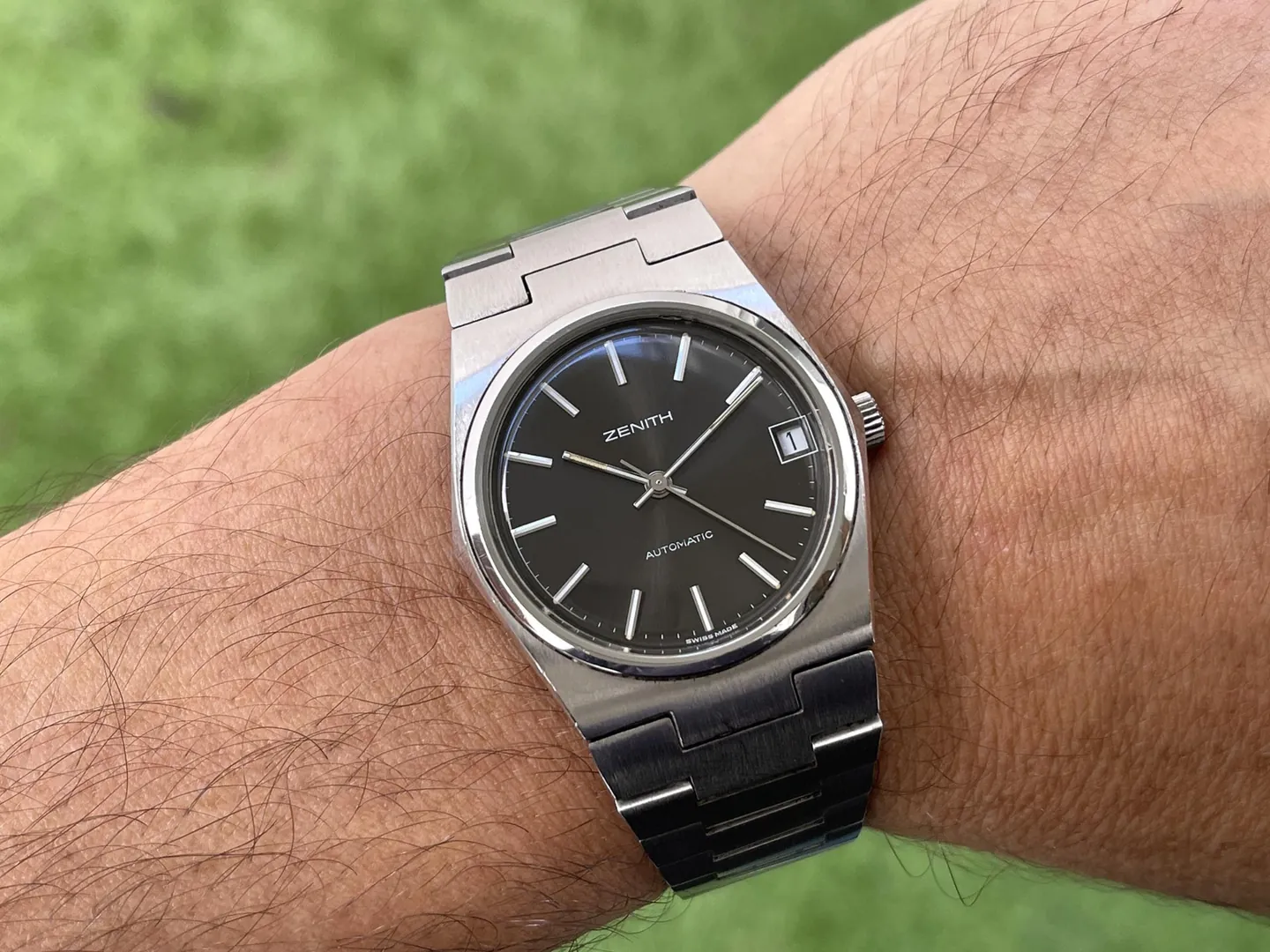
Zenith Surf automatic from the 1970s: tonneau case, black dial and integrated steel bracelet.
Baume & Mercier and the other discreet Swiss makers
Below the €1,000 mark there is a whole category of honest Swiss watches nobody looks for: Baume & Mercier, Eterna, Certina, Movado, Zodiac. A Baume & Mercier 1726 in a shaped case, at around €850, offers dial finishing and case design that no new watch at that price can match.
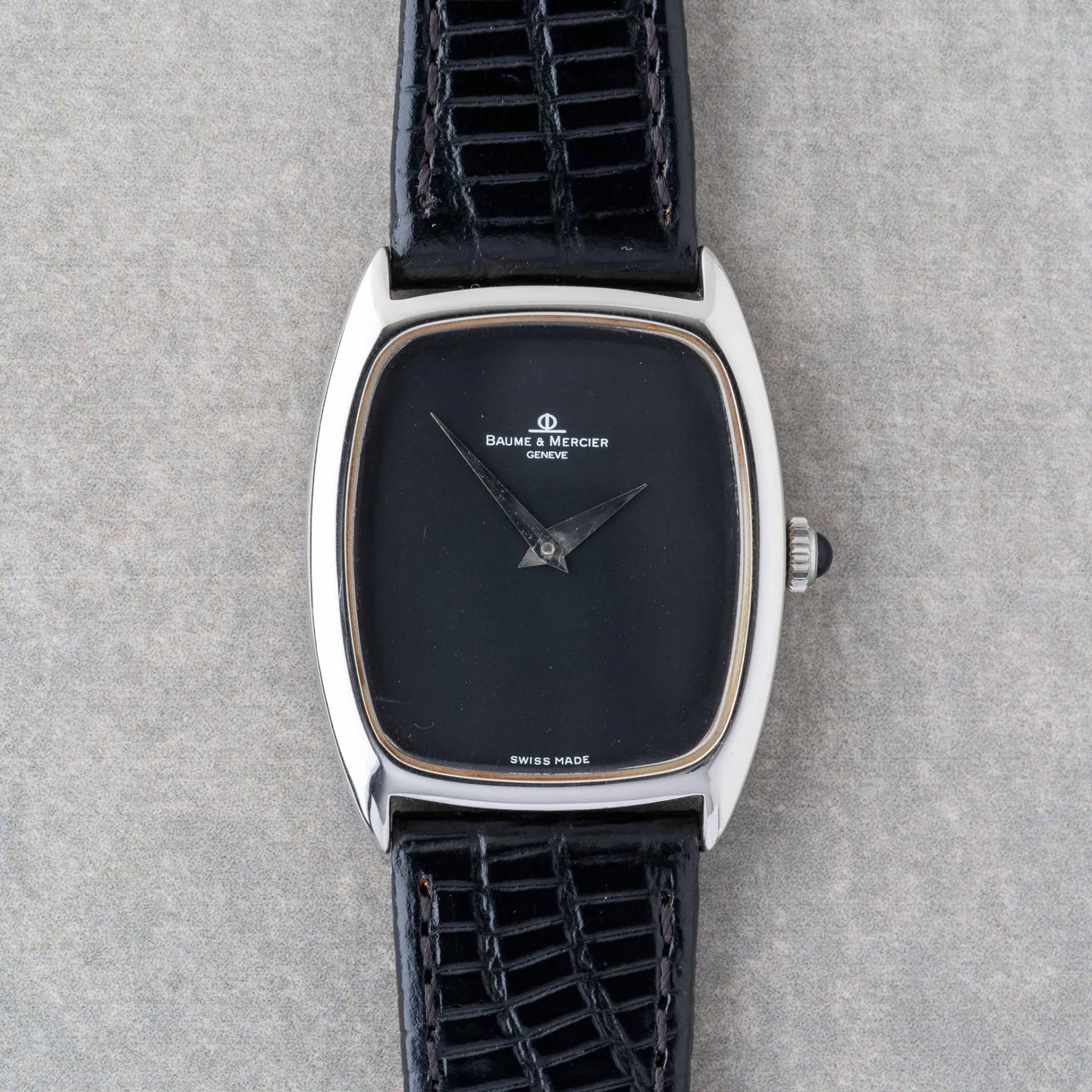
Baume & Mercier 1726: cushion case, black lacquered dial and dauphine hands, for about €850.
These brands carry no speculative market value, and that is the point: you buy them to wear, not to resell.
How to allocate a €1,500 budget
Three strategies stand up.
One fine watch. A Constellation chronometer or a Seamaster in a rare case will use the whole budget, but gives you a watch that will hold its value and has a real technical history.
Two complementary watches. An automatic Omega at around €800 for everyday, and a gold-plated Tissot or Universal Genève at around €500 for dress. This is the most rational choice for anyone starting out.
Keeping something in reserve. Buying at €1,000 and keeping €500 aside. A vintage watch bought with confidence, with a checked movement, avoids nasty surprises, but a reserve is always useful.
The five checks before buying
- The calibre matches the reference. A 166.020 case should contain a 552, 562 or 1020 depending on the year. An inconsistency points to franken parts.
- The dial is original. Crisp printing, coherent patina, indices properly aligned.
- The case is not over-polished. The edges between the brushed and polished surfaces must stay sharp. A rounded case has lost material and value.
- The crown and the crystal are correct. A generic crown is not a deal-breaker, but it is worth negotiating on.
- The provenance is traceable. A seller who knows where the watch came from and what has been done to it is worth more than a fine photograph with no history.
Where to see these watches in Liège
Every watch mentioned here physically passes through the shop in Herstal, on the edge of Liège. Stock changes constantly, and a watch seen online can look different on the wrist: diameter, weight and the way light falls on the dial do not photograph. Trying a watch on in person remains the best way to decide between two references.
The full catalogue can be consulted online, and a personalised search is possible for a specific reference that is not in stock.
Series: our guides sorted by budget
- Under €750: Seiko divers, 6139 chronographs and JDM models.
- Under €1,500: you are here. The accessible Swiss watches, Omega, Universal Genève, Longines.
- Under €2,000: Constellation chronometers and collectable Seamasters.
Related articles
- Vintage Seiko Buying Guide: Seiko 5, King Seiko & Grand SeikoA complete overview of collectable vintage Seiko watches: Seiko 5, King Seiko and Grand Seiko. Calibres, references, authentication method and market prices.
- Vintage Omega Buying Guide: Seamaster and ConstellationThe complete guide to choosing a vintage Omega Seamaster or Constellation: history, iconic references, calibres and practical advice for discerning collectors.
- Top 5 Vintage Seiko Divers Under €500 in BelgiumThe best affordable vintage Seiko divers, with their history and why they remain a safe bet for Belgian collectors.