How to Spot a Fake Omega: A Complete Guide for Collectors
By CharlemagneUpdated on 6 min read
How to spot a fake Omega watch before you buy
The vintage Omega market is one of the most active in Europe: Seamaster, Constellation, Speedmaster and De Ville change hands every day on specialist platforms, at auction and between collectors. This popularity has a downside. Redialled dials, movements rebuilt from orphaned parts, re-engraved cases and even fake Speedmasters made in Asia have flooded the listings. Before committing €1,500 or €25,000, authentication is no longer a precaution: it's a reflex.
At Charlemagne, in Herstal, we take apart every vintage Omega that enters stock. This guide shares the method we apply in the workshop, the five essential checks and the pitfalls specific to the most sought-after references.
 Spotting a fake vintage Omega always starts with a careful examination of the caseback and its engravings, under a 10x loupe.
The five non-negotiable checks
1. The movement serial number
Every Omega calibre carries a serial number engraved on the barrel bridge or on the rotor. This number must match the production year listed by the Omega Vintage Database, freely accessible online. A calibre 561 numbered in the 19,800,000 – 20,500,000 range corresponds to 1962-1963: it should then be fitted in a 168.005 case produced in the same window.
Warning sign: an illegible, partly erased serial number, or one inconsistent with the case reference. In 80% of cases, it's a "franken" movement assembled from salvaged parts.
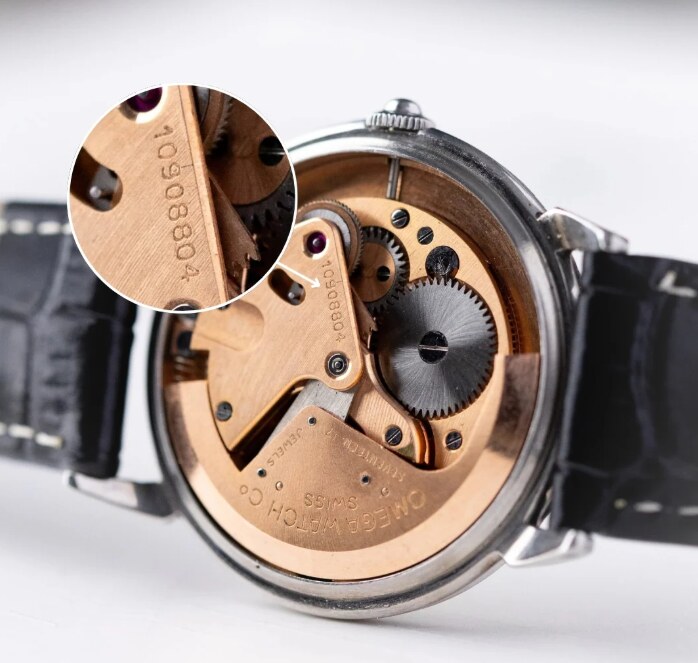 The serial number engraved on the calibre's bridge is the first checkpoint when spotting a fake vintage Omega.
2. The Ω-signed crown
On Seamaster and Constellation watches from 1955-1980, the crown carries the Ω logo engraved in relief. A smooth crown, or one marked with a different signature, almost always betrays a later replacement. On Speedmaster 145.022 and earlier references, the crown carries the same Ω signature: its absence weighs heavily in negotiation, without necessarily making the piece inauthentic.
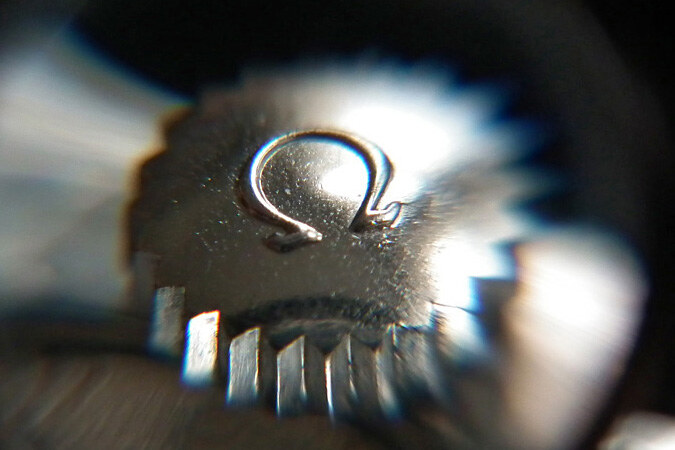 A genuine Omega crown always carries the Ω logo engraved in slight relief, visible under a 10x loupe.
3. The original dial, never redialled
The dial is the element that determines a vintage Omega's value. An original dial, even lightly patinated, is worth two to three times more than a restored dial. Four criteria distinguish a genuine dial:
- Applied indices in very slight relief, never glued flat.
- Omega logo printed crisply, with no bleeding, the Ω aligned perfectly above the word OMEGA.
- No halo around the Roman numerals or indices.
- Even patina: tritium lume turns ivory or a uniform beige, never in isolated patches.
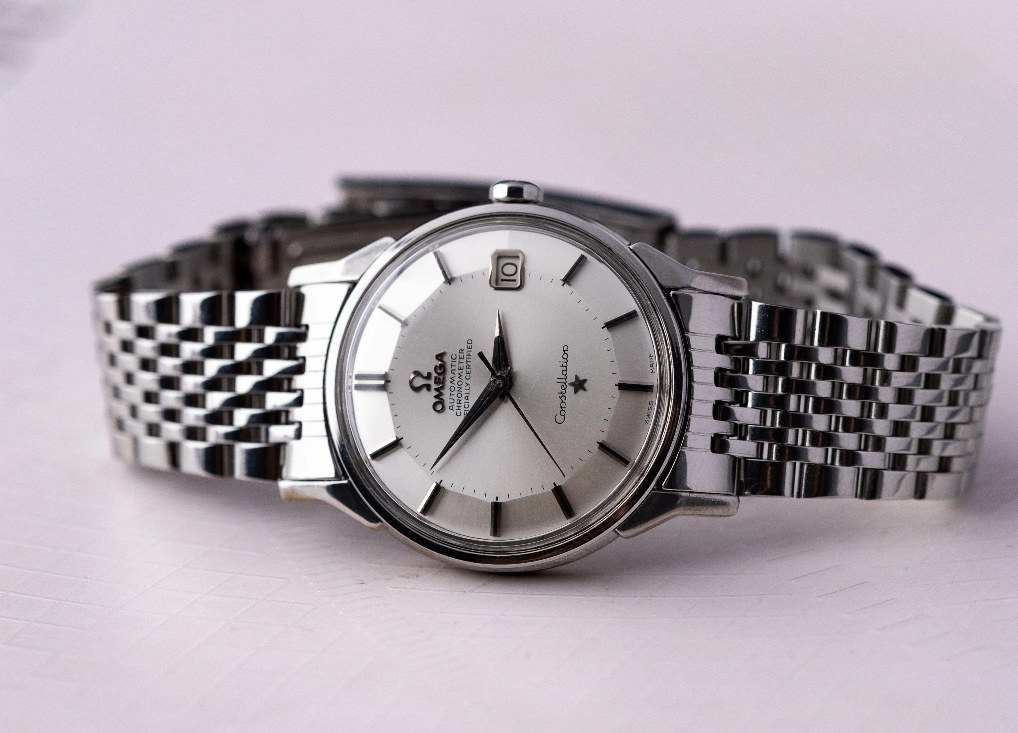
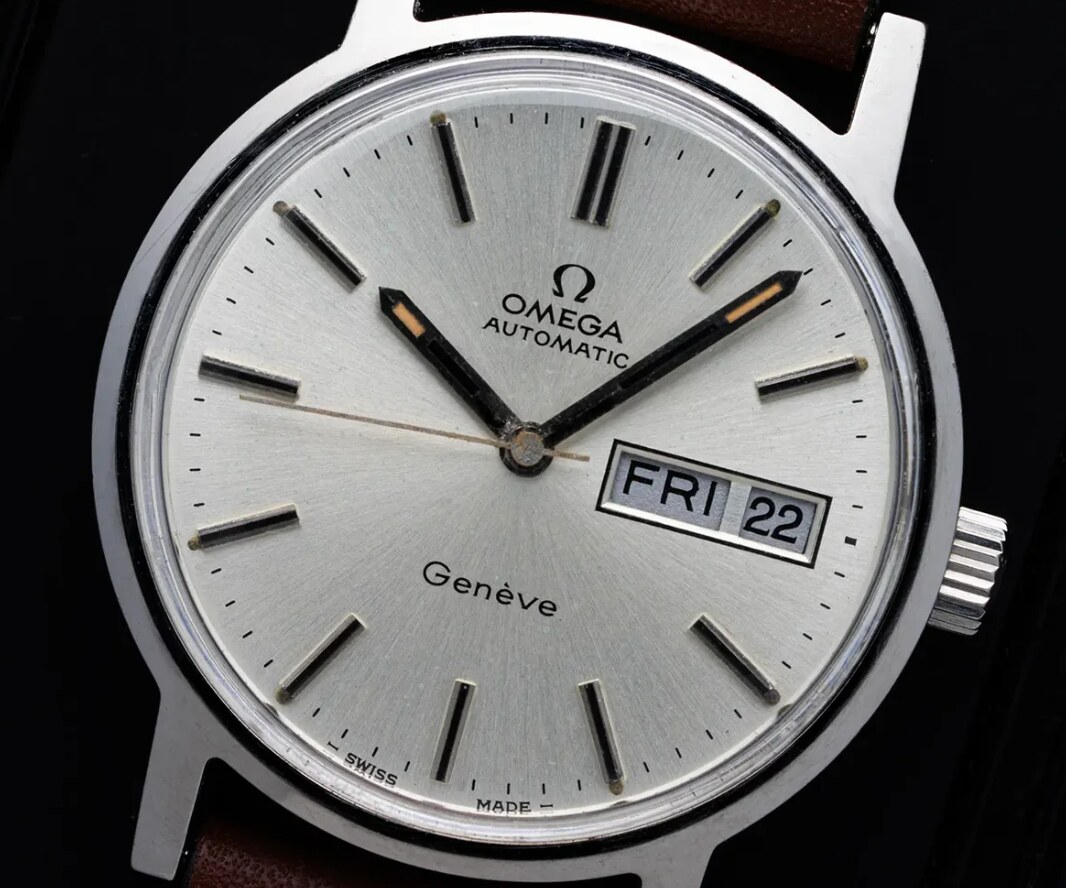 On a genuine Omega Constellation dial, the applied indices catch the light and the Ω logo stands out in relief.
4. Hands specific to the reference
Every Omega reference has its original hands: dauphine for the Constellation 14381 and 168.005, baton for the Seamaster De Ville 136.020, sword for the early Seamaster 2846. An incorrect set of hands doesn't disqualify the piece, but reduces its value by 15 to 25%. Omega's period catalogues, digitised by the community, remain the ultimate reference for checking.
5. The observatory medallion (Constellation only)
The caseback of a 1955-1975 Omega Constellation carries the observatory medallion engraved in relief: an observatory tower surrounded by eight stars. A blurred, too-regular or shallow medallion signals a replacement caseback, sometimes made recently. The original engraving is crisp, deep, and slightly irregular under a loupe.
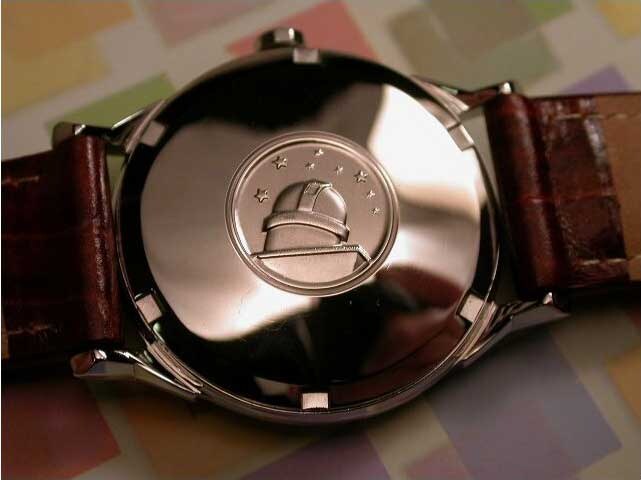 The observatory medallion in relief attests to the chronometer certification of a genuine Omega Constellation.
Pitfalls specific to each collection
Speedmaster Professional
Pre-Moon Speedmasters (105.012, 145.012) are the most heavily faked. Check:
- Calibre 321 or 861: the 321 has a visible column wheel, the 861 a cam. A
145.012Speedmaster should house a 321, not a later 861. - "Stepped" dial on Pre-Moon references: the edge of the dial shows a visible level break under a loupe.
- Crown and pushers signed Ω and unscrewed on references before 1970.
Seamaster 300 (CK2913, 165.024, 166.024)
The Seamaster 300 is heavily "frankenised":
- Original rotating bezel in painted bakelite on the
CK2913(not anodised aluminium as on reproductions). - Calibre 501, 552 or 565 depending on the reference, never a modern calibre.
- Case number engraved between the lugs at 6 o'clock, deep and regular.
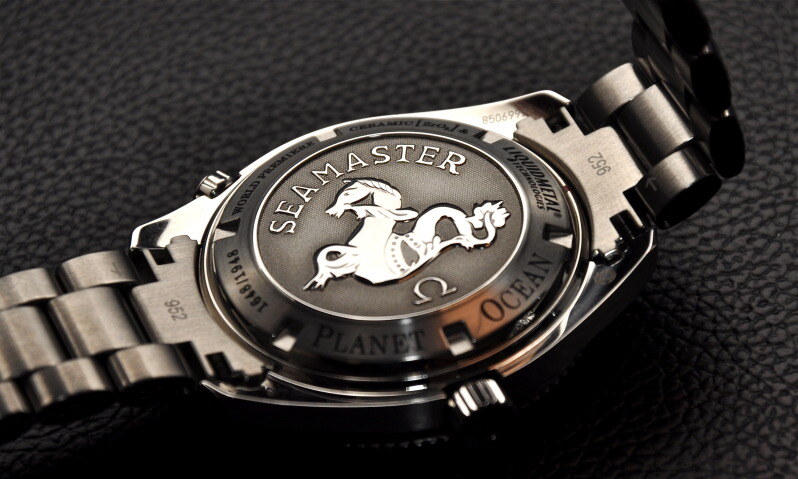
The genuine Seamaster caseback, here on a Ploprof, shows a crisp raised seahorse and deep, regular engravings.
Constellation Pie-Pan (168.005, 167.005)
The main pitfall is the redone dial: a repainted Pie-Pan loses the crisp facets of the original moulding. Tilt the dial under direct light: the twelve facets should catch the light distinctly, with no blurred transition.
The minimum kit for authenticating a watch yourself
The serious enthusiast invests in an authentication kit small enough to fit in a pouch:
- 10x watchmaker's loupe (Bergeon or equivalent).
- Case-back opening pliers with protected tips.
- High colour-temperature LED lamp (5,500 K) to reveal the dial's patina.
- Access to the Omega Vintage Database (free, online).
- Scanned period Omega catalogues (Omega Forums, OmegaWatches.com archives).
For pieces above €3,000, always have the watch validated by an independent watchmaker or a recognised expert before the transaction. An appraisal costs €80 to €150: cheap insurance against losing several thousand euros outright.
Documents that reassure (and those that lie)
- Omega archive extract: issued by Omega Vintage Service in Bienne on paid request (around CHF 120). It's the strongest proof of authenticity. Valuable but not essential.
- Original box and papers: a welcome bonus. Their absence disqualifies nothing on a watch aged 50 to 70 years.
- Previous owner's invoice: useful for traceability, never proof of authenticity in itself.
- Modern COSC certificates: worthless on a vintage piece.
Our workshop method at Charlemagne
In the Herstal workshop, every vintage Omega entering stock goes through seven steps:
- Dial examination under a 10x loupe and macro photography.
- Removal of the crown and checking of the Ω logo.
- Opening the caseback and reading the calibre's serial number.
- Cross-checking with the Omega Vintage Database.
- Rate testing over 48 hours, six positions.
- Macro photographs of the calibre, dial and caseback.
- Issuing a written certificate of authenticity, given to the buyer.
This level of scrutiny explains why our watches sometimes take a while to reach sale: a properly authenticated vintage Omega has to earn it.
Going further
Spotting a fake vintage Omega is not an esoteric discipline. It calls for method, a little equipment, and a good deal of humility given ever more sophisticated counterfeits. When in doubt, seek a second opinion: an independent appraisal costs far less than a mistake.
See our authenticated vintage Omega selection →
Read our Omega Seamaster and Constellation buying guide →
Request an appraisal or personal sourcing →
Article written by the Charlemagne Bijouterie Horlogère team, Herstal. Updated June 2026.
Related articles
- Vintage watches under €1,500: Omega, Longines, Universal Genève2026 buying guide to vintage Swiss watches under €1,500: Omega Genève, Dynamic, Seamaster and Constellation, Universal Genève Polerouter, Longines, Baume & Mercier, Tissot and Zenith. Calibres, references and real market values.
- Vintage Seiko Buying Guide: Seiko 5, King Seiko & Grand SeikoA complete overview of collectable vintage Seiko watches: Seiko 5, King Seiko and Grand Seiko. Calibres, references, authentication method and market prices.
- Must de Cartier: Chronicle of a Watchmaking Revolution (1973-2004)A historical chronicle of the Must de Cartier line (1973-2004): its birth, artistic direction, iconic models and rare pieces, seen from the Charlemagne workshop in Herstal-Liège.